International
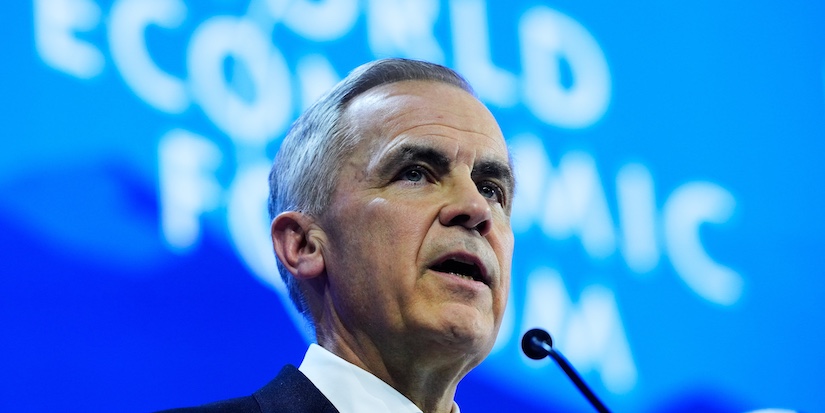
Prime Minister Mark Carney speaks during the Annual Meeting of the World Economic Forum in Davos, Switzerland, Tuesday, Jan. 20, 2026.
AP Photo/Markus Schreiber
Carney's speech to World Economic Forum draws praise, calls for action

Published 3:26 PST, Wed January 21, 2026


-
Prime Minister Mark Carney's call at the World Economic Forum for middle powers to band together against economic coercion by "great powers" is winning some cross-partisan support at home, and garnering attention all over the world.
The speech — which the Prime Minister's Office said Carney wrote himself — painted a grim picture of a world where global powers are increasingly using economic dominance for political coercion and where countries like Canada cannot continue to pretend the way things used to be is the way they will ever be again.
"In a world of great power rivalry the countries in between have a choice: compete with each other for favour or to combine to create a third path with impact," he said in a speech that drew a standing ovation in the room, and much reaction across Canada.
"What Mr. Carney is saying is also what I've been saying for a long time: the world has changed. We need to redesign our economy, we need to diversify our markets, we need to acknowledge that we can't claim to have an ally to the south," Quebec Premier François Legault said at a press conference in Quebec City.
Ontario Premier Doug Ford echoed Carney's message at a press conference in Toronto Wednesday.
"Before Prime Minister Carney even got elected last year, I was out in front of the Canadian people saying, 'We have to diversify our trade, we have to find new partners around the world, reliable partners,'" Ford said.
Carney never mentioned the United States or President Donald Trump by name, but it was clear that Trump's tariff-backed global economic shakeup was the target of Carney's comments about the use of "tariffs as leverage, financial infrastructure as coercion, supply chains as vulnerabilities to be exploited."
The speech drew a direct rebuke from Trump, who said Wednesday in his own address at the World Economic Forum in Davos, Switzerland, that Canada "should be grateful" to the United States.
"Canada lives because of the United States. Remember that, Mark, the next time you make your statements," Trump said Wednesday morning.
In a lengthy response, Alberta Conservative MP Michelle Rempel Garner said the prime minister's words need to be accompanied by action.
"Prime Minister Carney’s speech must not be lauded as a victory in and of itself. Now he must do something much more difficult: deliver concrete, practical details on how Canada’s ruling political class will summon the necessary resolve, resources, and urgency to break through a decade of inertia," Rempel Garner wrote.
Conservative Leader Pierre Poilievre has not responded to the speech with any public statements.
Former Conservative foreign affairs minister Peter MacKay said the success of Carney's call to action depends on other countries being willing to risk Trump's wrath.
"Many I think are going to be a bit, if not a lot, intimidated by the president's words," MacKay said. "He's used Canada kind of as a punching bag and made an example of us before."
While MacKay said he believes it's in Canada's interests to reduce its reliance on the U.S., he has reservations about closer ties with China given the country's dire human rights record.
"Pivoting from the United States to China is a pretty bad scenario in terms of being reliant on anyone. At least in a few years time, and some might dispute this, Donald Trump is going to be retired or voted out of office, even if he were to even try to, perish the thought, run again," he said.
"Xi Jinping is still going to be there."
Interim NDP leader Don Davies said in a media statement he agrees with the direction Carney laid out in his speech and called it "overdue."
But Davies said Carney's message is undercut by his government talking about joining Trump's unbuilt "Golden Dome" missile defence system and dropping the digital services tax, which was strongly opposed by Trump and U.S. tech companies.
Lauren Dobson-Hughes, a principle at LDH Consulting who has worked for the U.K. Labour Party and advised former NDP leader Jack Layton, said Carney delivered a "seminal" speech calling out "mobster diplomacy."
She also said she fears Canada is abandoning soft power goals of promoting freedom, equality and democracy with an economy-focused foreign policy that has seen Ottawa sign strategic partnerships with China and Qatar.
"If that's all we're doing, just defending jobs and buying military equipment, it's a downward spiral. Where's the vision of a world we want to create, where people are equal and free? Because that's ultimately, surely what we're working toward," Dobson-Hughes said.
"I know that sounds a bit naive … but we are in dark and dangerous times. And as Carney himself said, the time for small ideas is over."
George Magnus, an economist at the University of Oxford China Centre, said on social media that Carney delivered a "cometh the hour" speech that delivered an important message to audiences outside the U.S. and China.
But he took issue with Carney's repeated references to an anti-Communist essay written by author and former Czech Republic president Václav Havel — just days after the prime minister signed a strategic partnership with Beijing.
("Carney) is prone to see the U.S. in such excoriating terms but not China, which is equally awful or worse. As middle powers try to tread one way, frying pan into fire isn't such a good look," Magnus wrote on X.
The speech drew widespread international interest, with coverage by the BBC, the Australian Broadcasting Corporation, The Guardian, Spanish newspaper El Pais, German outlet Der Spiegel and Al Jazeera — all publications in countries that can be considered middle powers.
Several American outlets also covered the speech, including the Washington Post and the New York Times. The Times published Carney's speech in full.
This report by The Canadian Press was first published Jan. 21, 2026.
— With files from Morgan Lowrie in Montreal and Allison Jones in Toronto.











2 Hours of free financial consulting
Jai Xin Planning Ltd.
C$120.00 C$0.00

Use any of our home staging service and get a second month rental for free!
MiiX Interiors
C$500.00 C$0.00

Get 10% off any order
Phantom Screens Lower Mainland
C$200.00 C$180.00